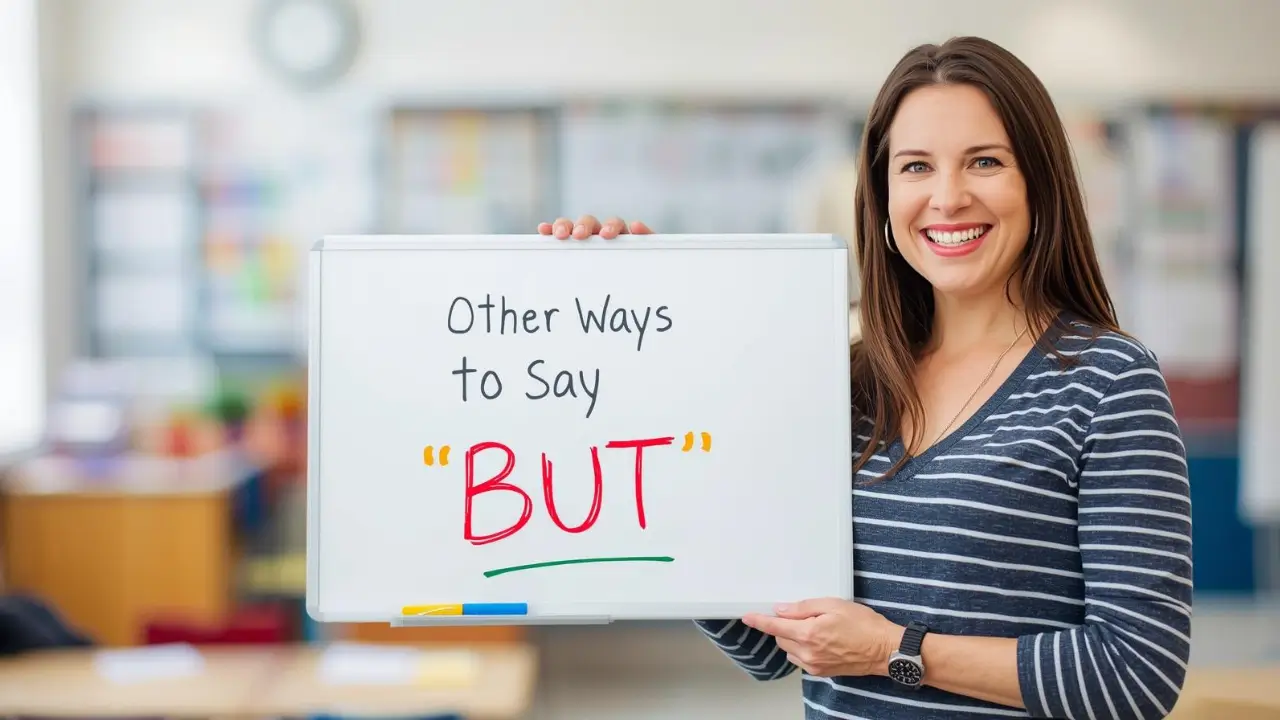

The word but is one of the most commonly used transition words in English. It is primarily used to show contrast or exception, helping to connect ideas in a sentence. However, overusing but can make writing repetitive or dull. Expanding your vocabulary with alternatives improves your writing clarity, sentence fluency, and vocabulary richness, whether in everyday English, academic writing, or creative writing.
This guide provides over 100 alternatives, complete with example sentences, usage tips, and formal vs informal distinctions, so you can replace but confidently in any context.
What Does But Mean?
But has two main functions:
- Contrast – Shows a difference or opposition between two ideas.
Example: “I wanted to go hiking, but it started raining.”
- Exception – Excludes something or someone from a statement.
Example: “Everyone attended the meeting but Ali.”
Understanding these functions helps you select the most appropriate transition words, linking phrases, or idiomatic expressions.
Contrast Alternatives

When your sentence expresses contrast, these words and phrases can be used instead of “but” to create smoother, more natural writing.
Yet is used for mild contrast in both formal and informal writing.
Example: I studied hard, yet I didn’t pass.
However shows strong contrast and is mostly used in formal writing.
Example: She wanted to help; however, she was busy.
Although introduces contrast and works in both formal and casual writing.
Example: Although it was raining, we went outside.
Though expresses casual contrast and sounds more informal.
Example: Though tired, he continued working.
Nevertheless emphasizes contrast and is usually used in formal writing.
Example: The task was tough; nevertheless, she finished it.
Nonetheless has a similar meaning to nevertheless and is also formal.
Example: The show was boring; nonetheless, I stayed till the end.
On the other hand presents an opposite viewpoint in both formal and informal contexts.
Example: I love summer; on the other hand, my brother prefers winter.
Still shows mild contrast and is commonly used in informal writing.
Example: He was late, still he completed the assignment.
Exception Alternatives
When you want to express exception or exclusion instead of using “but”, these alternatives work well.
Except is used to exclude someone or something and fits both formal and informal writing.
Example: Everyone passed except Sara.
Aside from indicates exclusion and works in both casual and formal tone.
Example: Aside from the broken chair, the room was perfect.
Other than excludes certain items and is commonly used in everyday writing.
Example: Other than minor errors, the report was flawless.
Excluding is a more formal way to show exclusion.
Example: Excluding Sundays, the store is open daily.
Barring shows conditional exclusion and is formal.
Example: Barring unforeseen issues, the event will proceed.
Save is a literary or formal way to express exclusion.
Example: Save for one error, the document is perfect.
Read Also:
Linking Phrases & Idiomatic Expressions
These phrases replace “but” in creative, idiomatic, or formal writing situations.
In contrast to shows an opposing idea in both formal and informal writing.
Example: In contrast to his brother, he enjoys hiking.
That said adds mild qualification and is informal.
Example: The exam was hard. That said, I felt prepared.
Be that as it may is a formal idiomatic expression.
Example: The project is delayed; be that as it may, quality remains high.
Even so expresses mild contrast in informal writing.
Example: It rained heavily; even so, we went hiking.
All the same shows mild disagreement and sounds informal.
Example: He disagreed with the plan; all the same, he helped.
Regardless ignores obstacles and is formal.
Example: Regardless of difficulties, she finished her work.
Notwithstanding expresses formal exception or contrast.
Example: Notwithstanding the challenges, the team succeeded.
In spite of that contrasts a previous statement and works in both tones.
Example: In spite of that setback, the project continued.
Full Sentence Examples
- Original: “I like pizza, but I don’t like cheese.”
Alternative: “I like pizza; however, I don’t like cheese.”
- Original: “She was tired, but she continued working.”
Alternative: “She was tired; nevertheless, she continued working.”
- Original: “Everyone attended the seminar but Maria.”
Alternative: “Everyone attended the seminar except Maria.”
- Original: “I wanted to travel, but the cost was high.”
Alternative: “I wanted to travel; on the other hand, the cost was high.”
- Original: “I tried to fix the car, but I failed.”
Alternative: “I tried to fix the car; even so, I failed.”
100+ Alternatives Table (Grouped)
Contrast Words: yet, however, although, though, nevertheless, nonetheless, on the other hand, still, conversely, in contrast
Exception Words: except, aside from, other than, excluding, barring, save, without, aside from that
Idiomatic Expressions: that said, be that as it may, even so, all the same, in spite of that, notwithstanding
Formal Writing Alternatives: however, nevertheless, nonetheless, notwithstanding, in contrast to, excluding
Informal Alternatives: still, though, that said, on the other hand, aside from, even so
Tips for Using Alternatives Effectively
- Identify sentence function – Is it contrast or exception?
- Select the right word/phrase – Consider tone and formality.
- Use proper punctuation – Words like however and nevertheless often need a semicolon.
- Vary your usage – Avoid replacing but with the same word repeatedly.
- Practice in context – Show alternatives in real-life sentences for better retention.
Common Mistakes to Avoid
- Misplacing however without correct punctuation.
- Overusing informal words like still in academic writing.
- Using idiomatic phrases in overly formal contexts.
- Replacing but with unrelated words that change the meaning.
FAQ
Q1: Can I always replace but with another word?
A1: Not always. The replacement depends on context, tone, and formality.
Q2: Which alternatives are best for essays or professional writing?
A2: However, nevertheless, nonetheless, although, and notwithstanding are best.
Q3: Are idiomatic phrases acceptable in casual writing?
A3: Yes, phrases like that said, even so, and on the other hand work well.
Conclusion
Replacing but with suitable alternatives enhances writing clarity, vocabulary, and fluency. Using contrast words, exception words, idiomatic expressions, and formal/informal phrases lets you express ideas more effectively. Practice these alternatives in academic, creative, and casual writing to sound more professional, fluent, and versatile.